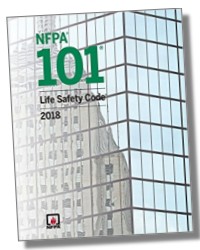
NFPA 101
Life Safety Code
2018
Edition
Major changes and an
expanded scope make the 2018 edition of NFPA 101®, Life Safety Code®
essential in any occupancy -- from assembly to health care,
industrial, and residential.
As the built environment and
risks evolve, so do the challenges to protect people from fire and
related hazards. NFPA®'s Life Safety Code is the most widely used
source for strategies for occupant safety throughout the life of
a building.
Vital for architects,
engineers, building owners and building managers, hospital
administrators, and AHJs, NFPA 101 covers it all: Egress,
sprinklers, alarms, emergency lighting, smoke barriers, special
hazard protection, and much more.
For the
2018 edition, the scope of NFPA 101
is expanded to include hazardous materials emergencies, injuries
from falls, and emergency communications.
The Code provides a flexible
approach that adapts to nontraditional use of buildings; innovative
designs; and new technologies, materials, and construction
practices. It addresses life safety in both new and existing
structures. Significant changes for the 2018 edition include:
-
New requirements for
hazardous materials protection of other than fire-related
hazards (Chapter 8)
-
A new reference to NFPA
4 for integrated fire protection and life safety system testing,
and new provisions for risk analyses for mass notification
systems (Chapter 9)
-
Animal housing
facilities added as special structures (Chapter 11)
-
Added requirements for
carbon-monoxide detection in new assembly occupancies and new
residential board and care occupancies (Chapters 12 and 32)
-
Added criteria for door
locking to prevent unwanted entry in educational, day care, and
business occupancies (Chapters 14-17, 38, and 39)
-
A mandatory sprinkler
requirement for all but very small new educational occupancies
(Chapter 14)
-
New provisions that
permit health care and ambulatory health care smoke compartments
up to 40,000 ft2 (3720 m2) in area (Chapters 18 and 19)
-
Added requirements for
bathtub and shower grab bars, which are then referenced by
numerous occupancy chapters (Chapter 24)
-
Added requirements for
attic protection requirements that impact certain new hotels and
dormitories and apartment buildings (Chapters 28 and 30)
-
A new reference to NFPA
99 for medical gases in business occupancies (Chapters 38 and
39)
-
A new Annex C that
offers guidance on several NFPA® hazardous materials standards
to assist users with the new hazardous materials protection
requirements
Be sure your knowledge is
up-to-date and your facilities meet code. Base your decisions on the
2018 edition of NFPA 101 and tackle safety challenges effectively.
(Softbound, 568 pp., 2018)
Contents:
Chapter 1 Administration
1.1 Scope
1.2 Purpose
1.3 Application
1.4 Equivalency
1.5 Units and Formulas
1.6 Enforcement
Chapter 2 Referenced Publications
2.1 General
2.2 NFPA Publications
2.3 Other Publications
2.4 References for Extracts in Mandatory Sections
Chapter 3 Definitions
3.1 General
3.2 NFPA Official Definitions
3.3 General Definitions
Chapter 4 General
4.1 Goals
4.2 Objectives
4.3 Assumptions
4.4 Life Safety Compliance Options
4.5 Fundamental Requirements
4.6 General Requirements
4.7 Fire Drills
4.8 Emergency Plan
Chapter 5 Performance-Based Option
5.1 General Requirements
5.2 Performance Criteria
5.3 Retained Prescriptive Requirements
5.4 Design Specifications and Other Conditions
5.5 Design Fire Scenarios
5.6 Evaluation of Proposed Designs
5.7 Safety Factors
5.8 Documentation Requirements
Chapter 6 Classification of Occupancy and
Hazard of Contents
6.1 Classification of Occupancy
6.2 Hazard of Contents
Chapter 7 Means of Egress
7.1 General
7.2 Means of Egress Components
7.3 Capacity of Means of Egress
7.4 Number of Means of Egress.
7.5 Arrangement of Means of Egress
7.6 Measurement of Travel Distance to Exits
7.7 Discharge from Exits
7.8 Illumination of Means of Egress
7.9 Emergency Lighting
7.10 Marking of Means of Egress
7.11 Special Provisions for Occupancies with High Hazard
Contents
7.12 Special Provisions
for Hazardous Materials.
7.13 Mechanical Equipment Rooms, Boiler Rooms, and Furnace
Rooms
7.14 Normally Unoccupied Building Service Equipment Support
Areas
7.15
Occupant Evacuation Elevators
Chapter 8 Features of Fire Protection
8.1 General
8.2 Construction and Compartmentation
8.3 Fire Barriers
8.4 Smoke Partitions
8.5 Smoke Barriers
8.6 Vertical Openings
8.7 Special Hazard Protection
8.8 Inspection and Testing
of Door Assemblies
Chapter 9 Building Service and Fire
Protection Equipment
9.1 Utilities
9.2 Heating, Ventilating, and Air-Conditioning
9.3 Smoke Control
9.4 Elevators, Escalators, and Conveyors
9.5 Waste Chutes, Incinerators, and Laundry Chutes.
9.6 Fire Detection, Alarm, and Communications Systems.
9.7 Automatic Sprinklers.
9.8 Other Automatic Extinguishing Equipment.
9.9 Portable Fire Extinguishers.
9.10 Standpipe Systems.
9.11 Fire Protection System Operating Features.
9.12 Carbon Monoxide (CO) Detection and Warning Equipment.
9.13 Special Inspections and Tests.
9.14 Risk Analysis for Mass Notification Systems
Chapter 10 Interior Finish, Contents, and
Furnishings
10.1 General
10.2 Interior Finish
10.3 Contents and Furnishings
Chapter 11 Special Structures and High-Rise
Buildings
11.1 General Requirements
11.2 Open Structures
11.3 Towers
11.4 Water-Surrounded Structures
11.5 Piers
11.6 Vehicles and Vessels
11.7 Underground and Limited Access Structures
11.8 High-Rise Buildings
11.9 Permanent Membrane Structures
11.10 Temporary Membrane Structures
11.11 Tents
11.12 Animal Housing Facilities
Chapter 12 New Assembly Occupancies
12.1 General Requirements
12.2 Means of Egress Requirements
12.3 Protection
12.4 Special Provisions
12.5 Building Services
12.6 Reserved
12.7 Operating Features
Chapter 13 Existing Assembly Occupancies
13.1 General Requirements
13.2 Means of Egress Requirements
13.3 Protection
13.4 Special Provisions
13.5 Building Services
13.6 Reserved
13.7 Operating Features
Chapter 14 New Educational Occupancies
14.1 General Requirements
14.2 Means of Egress Requirements
14.3 Protection
14.4 Special Provisions
14.5 Building Services
14.6 Reserved
14.7 Operating Features
Chapter 15 Existing Educational Occupancies
15.1 General Requirements
15.2 Means of Egress Requirements
15.3 Protection
15.4 Special Provisions
15.5 Building Services
15.6 Reserved
15.7 Operating Features
Chapter 16 New Day-Care Occupancies
16.1 General Requirements
16.2 Means of Egress Requirements
16.3 Protection
16.4 Special Provisions
16.5 Building Services
16.6 Day-Care Homes
16.7 Operating Features
Chapter 17 Existing Day-Care Occupancies
17.1 General Requirements
17.2 Means of Egress Requirements
17.3 Protection
17.4 Special Provisions
17.5 Building Services
17.6 Day-Care Homes
17.7 Operating Features
Chapter 18 New Health Care Occupancies
18.1 General Requirements
18.2 Means of Egress Requirements
18.3 Protection
18.4 Special Provisions
18.5 Building Services
18.6 Reserved
18.7 Operating Features
Chapter 19 Existing Health Care Occupancies
19.1 General Requirements
19.2 Means of Egress Requirements
19.3 Protection
19.4 Special Provisions
19.5 Building Services
19.6 Reserved
19.7 Operating Features
Chapter 20 New Ambulatory Health Care
Occupancies
20.1 General Requirements
20.2 Means of Egress Requirements
20.3 Protection
20.4 Special Provisions
20.5 Building Services
20.6 Reserved
20.7 Operating Features
Chapter 21 Existing Ambulatory Health Care
Occupancies
21.1 General Requirements
21.2 Means of Egress Requirements
21.3 Protection
21.4 Special Provisions
21.5 Building Services
21.6 Reserved
21.7 Operating Features
Chapter 22 New Detention and Correctional
Occupancies
22.1 General Requirements
22.2 Means of Egress Requirements
22.3 Protection
22.4 Special Provisions
22.5 Building Services
22.6 Reserved
22.7 Operating Features
Chapter 23 Existing Detention and
Correctional Occupancies
23.1 General Requirements
23.2 Means of Egress Requirements
23.3 Protection
23.4 Special Provisions
23.5 Building Services
23.6 Reserved
23.7 Operating Features
Chapter 24 One- and Two-Family Dwellings
24.1 General Requirements
24.2 Means of Escape Requirements
24.3 Protection
24.4 Reserved
24.5 Building Services
Chapter 25 Reserved
Chapter 26 Lodging or Rooming Houses
26.1 General Requirements
26.2 Means of Escape Requirements
26.3 Protection
26.4 Reserved
26.5 Building Services
26.6 Reserved
26.7 Operating Features
Chapter 27 Reserved
Chapter 28 New Hotels and Dormitories
28.1 General Requirements
28.2 Means of Egress Requirements
28.3 Protection
28.4 Special Provisions
28.5 Building Services
28.6 Reserved
28.7 Operating Features
Chapter 29 Existing Hotels and Dormitories
29.1 General Requirements
29.2 Means of Egress Requirements
29.3 Protection
29.4 Special Provisions
29.5 Building Services
29.6 Reserved
29.7 Operating Features
Chapter 30 New Apartment Buildings
30.1 General Requirements
30.2 Means of Egress Requirements
30.3 Protection
30.4 Special Provisions
30.5 Building Services
30.6 Reserved
30.7 Operating Features
Chapter 31 Existing Apartment Buildings
31.1 General Requirements
31.2 Means of Egress Requirements
31.3 Protection
31.4 Special Provisions
31.5 Building Services
31.6 Reserved
31.7 Operating Features
Chapter 32 New Residential Board and Care
Occupancies
32.1 General Requirements
32.2 Small Facilities
32.3 Large Facilities
32.4 Suitability of an Apartment Building to House a Board
and Care Occupancy
32.5 Reserved
32.6 Reserved
32.7 Operating Features
Chapter 33 Existing Residential Board and
Care Occupancies
33.1 General Requirements
33.2 Small Facilities
33.3 Large Facilities
33.4 Suitability of an Apartment Building to House a Board
and Care Occupancy
33.5 Reserved
33.6 Reserved
33.7 Operating Features
Chapter 34 Reserved
Chapter 35 Reserved
Chapter 36 New Mercantile Occupancies
36.1 General Requirements
36.2 Means of Egress Requirements
36.3 Protection
36.4 Special Provisions
36.5 Building Services
36.6 Reserved
36.7 Operating Features
Chapter 37 Existing Mercantile Occupancies
37.1 General Requirements
37.2 Means of Egress Requirements
37.3 Protection
37.4 Special Provisions
37.5 Building Services
37.6 Reserved
37.7 Operating Features
Chapter 38 New Business Occupancies
38.1 General Requirements
38.2 Means of Egress Requirements
38.3 Protection
38.4 Special Provisions
38.5 Building Services
38.6 Reserved
38.7 Operating Features
Chapter 39 Existing Business Occupancies
39.1 General Requirements
39.2 Means of Egress Requirements
39.3 Protection
39.4 Special Provisions
39.5 Building Services
39.6 Reserved
39.7 Operating Features
Chapter 40 Industrial Occupancies
40.1 General Requirements
40.2 Means of Egress Requirements
40.3 Protection
40.4 Special Provisions — High-Rise Buildings
40.5 Building Services
40.6 Special Provisions for Aircraft Servicing Hangars
40.7 Operating Features
Chapter 41 Reserved
Chapter 42 Storage Occupancies
42.1 General Requirements
42.2 Means of Egress Requirements
42.3 Protection
42.4 Special Provisions — High-Rise Buildings
42.5 Building Services
42.6 Special Provisions for Aircraft Storage Hangars
42.7 Special Provisions for Grain Handling, Processing,
Milling, or Other Bulk Storage Facilities
42.8 Special Provisions for Parking Structures
42.9 Operating Features
Chapter 43 Building Rehabilitation
43.1 General
43.2 Special Definitions
43.3 Repairs
43.4 Renovations
43.5 Modifications
43.6 Reconstruction
43.7 Change of Use or Occupancy Classification
43.8 Additions
43.9 Reserved
43.10 Historic Buildings
Annex A Explanatory Material
Annex B Supplemental Evacuation Equipment
Annex C NFPA Documents on Hazardous Materials
Annex D Informational References
Index
9781455916832,
1455916838
|











 Order online:
 Add
Add  Order offline:


