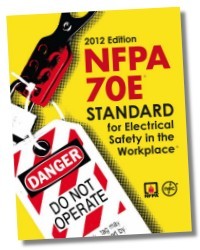
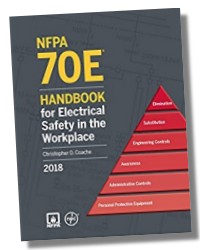
NFPA 70E
Standard
for Electrical Safety in the Workplace,
2018 Ed.
Keep the workplace safe from electrical hazards using the 2018
edition of NFPA 70E®
In a fraction of a second, an
electrical incident can claim lives and cause permanently disabling
injuries. In fact, hundreds of deaths and thousands of burn injuries
occur each year due to shock, electrocution, arc flash, and arc
blast -- and most could be prevented through compliance with NFPA
70E: Standard for Electrical Safety in the Workplace®.
Originally developed at OSHA's request, NFPA 70E responds to
the latest information about the effects of arc flash, arc blast,
and direct current (dc) hazards, and recent developments in
electrical design and
Personal Protective Equipment (PPE). It provides vital
information that helps you comply with OSHA 1910 Subpart S and OSHA
1926 Subpart K.
Make sure everyone goes home at night. New NFPA 70E
explicitly states that the first priority must be the elimination of
the hazard.
The Standard continues to evolve to address risk assessment and
introduces human factors, such as human error, as part of that
assessment. Annex Q, Human Performance and Workplace Electrical
Safety, is included to provide guidance. NFPA 70E emphasizes
the need to use the hierarchy of risk controls, by moving it from an
informational note into the text of the Standard. NFPA 70E
now explicitly states that the first priority must be the
elimination of the hazard.
Other changes in this edition:
-
A modified arc flash hazard
identification table [Table 130.7(C)(15)(A)(a)] makes it easier
to determine the likelihood that an arc flash could occur.
-
Reorganized Article 120
presents the requirements for establishing an electrically safe
work condition in a logical order of application of the program.
-
Changes to Article 320
introduce voltage thresholds of 100 Vdc specifically for
batteries and battery rooms to cover the unique situations in
these locations.
-
Extensively revised, Article
330 on lasers now focuses on safety-related maintenance issues
rather than issues associated with laser use.
-
Article 350 introduces an
Electrical Safety Authority as a possible authority having
jurisdiction for laboratories.
Bring your company's electrical
safety program up-to-date and give employees critical knowledge.
If you're responsible for ensuring workers are protected from shock
and arc flash hazards, use the 2018 edition of NFPA 70E along
with NFPA 70®: National Electrical
Code® (NEC®) and NFPA 70B: Electrical Equipment Maintenance.
Together, the "Big Three" help you protect your personnel and your
company from tragic loss.
NFPA 70E
is a vital tool for contractors, risk managers, engineers,
building managers, owners, and everyone concerned with ending
electrical-related accidents, liability, and loss.
Contents:
NFPA 70E Standard for
Electrical Safety in the Workplace 2015 Edition
90 Introduction
Chapter 1 Safety-Related Work Practices
100 Definitions
105 Application of Safety-Related Work Practices
110 General Requirements for Electrical Safety-Related Work
Practices
120 Establishing an Electrically Safe Work Condition
130 Work Involving Electrical Hazards
Chapter 2 Safety-Related Maintenance
Requirements
200 Introduction
205 General Maintenance Requirements
210 Substations, Switchgear Assemblies, Switchboards,
Panelboards, Motor Control Centers, and Disconnect Switches
215 Premises Wiring
220 Controller Equipment
225 Fuses and Circuit Breakers
230 Rotating Equipment
235 Hazardous (Classified) Locations
240 Batteries and Battery Rooms
245 Portable Electric Tools and Equipment
250 Personal Safety and Protective Equipment
Chapter 3 Safety Requirements for Special
Equipment
300 Introduction
310 Safety-Related Work Practices for Electrolytic Cells
320 Safety Requirements Related to Batteries and Battery
Rooms
330 Safety-Related Work Practices for Use of Lasers
340 Safety-Related Work Practices: Power Electronic
Equipment
350 Safety-Related Work Requirements: Research and
Development Laboratories
Annex A Referenced Publications
Informative Annex B Informational
References
Informative Annex C Limits of Approach
Informative Annex D Incident Energy and
Arc Flash Boundary Calculation Methods
Informative Annex E Electrical Safety
Program
Informative Annex F Hazard Analysis,
Risk Estimation, and Risk Evaluation Procedure
\
Informative Annex G Sample
Lockout/Tagout Procedure
Informative Annex H Guidance on
Selection of Protective Clothing and Other Personal Protective
Equipment
Informative Annex I Job Briefing and
Planning Checklist
Informative Annex J Energized
Electrical Work Permit
Informative Annex K General Categories
of Electrical Hazards
Informative Annex L Typical Application
of Safeguards in the Cell Line Working Zone
Informative Annex M Layering of
Protective Clothing and Total System Arc Rating
Informative Annex N Example Industrial
Procedures and Policies for Working Near Overhead Electrical
Lines and Equipment
Informative Annex O Safety-Related
Design Requirements
Informative Annex P Aligning
Implementation of This Standard with Occupational Health and
Safety Management Standards
Informative Annex Q
Human Performance and Workplace Electrical Safety
Index
(Softbound, 104 pages., 2018)
Related:
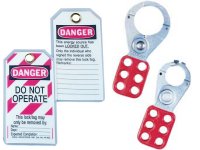
Lockout/Tagout Supplies
Lockout/Tagout
Kits
* * * * * * *
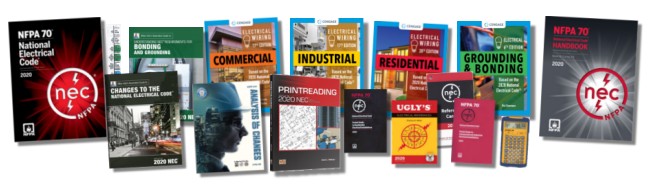
2020 NEC & Related Reference & Study
Guides
9781455916719 / 9781455908936
|










 Order online:
 Add
Add  Order offline:


